1988.
One fateful night an orphan had a change of heart and refused to help a gang of Titan City youths to mug a man in a movie theater alleyway. Over fifty years later on a hot summer’s day, a convicted felon approached that same theater. Although separated by time, they shared a name, a mantle, and a mission — the Crimson Wraith.
But Hank wasn’t there to fulfill a legacy. Jasmine — the first person in his life who had thought he could do something good with it, the woman who promised he wouldn’t have to do it alone — was in the clutches of a crazed killer. If defending the defenseless as the Crimson Wraith was good for anything, it should be rescuing her.
Broken bottles and discarded newspaper gathered around the doorways to the Regent. But the way they had been swept aside from one showed it had been opened recently.
Hank tried the handle, and it swung out for him. He slipped on his black ski mask with its white, painted skull, pulled up the hood on his red sweatshirt, and stepped inside.
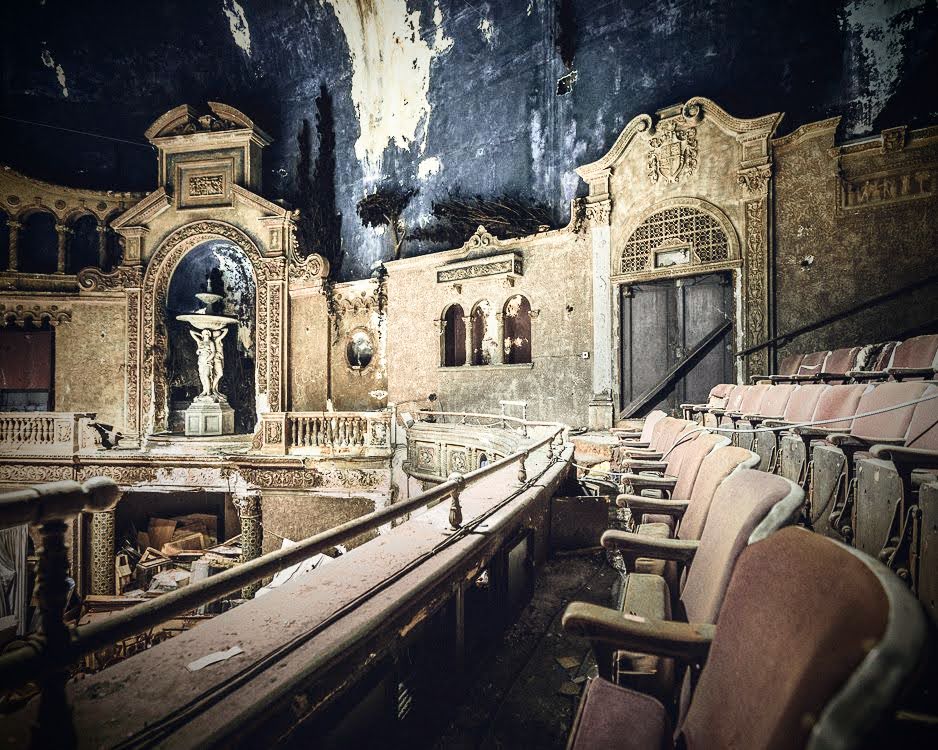
Officially, the Regent had been closed for seventeen years, since the ill-fated 1971 reunion concert for the Buggies where lead guitarist James Starling was shot and murdered on-stage by a man who claimed he found Satanic messages in their music by playing the records backward. No one ever came back to clean up after that night. Popcorn bags and ticket stubs lay strewn across floors whose once-lavish, richly patterned carpets had faded and frayed long ago.
While it should have been dark inside the abandoned theater, portable work lights lit up a series of white arrows spray painted on the ceiling, walls, and concession stand, pointing him toward the auditorium. The words “CRIMSON WRAITH THIS WAY” had been painted above the door.
The architects of the Regent had worked in an age when cinema was new and gilded with grandeur, and Hank stepped into an auditorium meant to suggest Shakespeare’s A Midsummer Night’s Dream. Its ceiling had been painted midnight blue, decorated with stars and, at its center, Diana, goddess of the moon, stood with the string on her silver bow pulled taut, ready to fire.
Below this painted sky, the false fronts of Greek buildings with their carved columns worked their way around the audience and stage. Flower-crowned fairies peeked out from around corners, and high above the proscenium, Titania, Queen of the Fairies, cradled her donkey-headed lover in her arms.
The work lights shone harsh and bright on plaster faces chipped by years of neglect. They stared at him with hollow eyes, cheeks half fallen off, their smiles now more menacing than mirthful.
More painted arrows guided Hank down the auditorium aisle, pointing toward a darkened stage where he could just make out large, squarish shapes within the shadows.
Then a gravelly voice called to Hank, its source unseen. It rang through the auditorium with dramatic tones that rose and fell for exaggerated emphasis, “Welcome, oh, Scarlet Stranger! Welcome!”
Startled, Hank cocked his fist, ready to swing, if only the villain would show himself.
The Troubador continued, “So glad you managed to interpret my invitation correctly. Truly, in you I have finally found one with the capacity to appreciate my art. And it pleases me that you have come dressed for the event, wearing your heroic disguise even though I know your name, Henry Mills.”
A guttural chuckle rippled across the auditorium. Hank didn’t flinch.
“Oh, this will be an excellent extravaganza! You and I, the Crimson Wraith and the Troubador, dancing this old duet to the tune of Titan City’s screams!”
Hank shouted into the surrounding dark, “Come on out! Face me!”
“My, my, aren’t we eager? But first we must establish terms. You will see me soon, and when you do you must know that I have two things in hand. The first, the camera, which you will see quite plainly — and quite plainly is how it will see you, filming your experience of my art, capturing its impression upon you. In my other hand, I will be holding a pistol pointed directly at your heart — just a little discouragement should you contemplate concluding the evening’s activities prematurely. We can’t have that now can we?”
All of this flowery talk just sounded like nonsense to Hank. He could tell the Troubador was enjoying himself, though, and refused to respond.
“No words to that? Silent as the grave? Ah, well, since silence implies consent, then let us proceed.”
A spotlight struck the stage, and the Troubador stepped into its glow. He wore the same long-nosed mask as his namesake from the sixties, but otherwise dressed plainly in a striped polo shirt and a pair of denim jeans.
As promised, on his right shoulder, he held a video camera. In his left, he held a pistol. Both pointed toward Hank.
The stage then flooded with light, illuminating two train boxcars, their sliding doors closed with words in red painted over each. Above the one on the left was written as a question, LADY? And above the other, TIGER?
“That Lady or the Tiger?” the Troubador proclaimed. “Written by Frank R. Stockton and published in a magazine called the Century almost exactly a century ago. You are of course familiar, being my worthy adversary. But I shall remind you that it tells of a mercurial king who leaves it up to his prisoners to decide their own fate. He presents them with two doors, each perfectly identical. One conceals a hungry tiger, who will viciously tear the prisoner apart. Behind the other stands a fair maiden that the prisoner may take for wife. It is a metaphor, you see? A metaphor for life!”
Hank exploded, “Just tell me where she is already!”
The Troubador gestured toward the boxcars. “Why, she is here! Or is she here? Behind one of these doors, you will find the Wily Wisp. But choose carefully because behind one door you will find…” He lost himself in laughter.
“A tiger,” said Hank.
“And he’s a very hungry boy. I know he would just love to meat you!” Another laugh. “Get it? Meat you?”
Hank nodded, unwilling to acknowledge the pun with words.
“Then get to it!” shouted the Troubador.
The set-up was too simple. Hank knew there had to be some kind of trick to it, something that could only amuse a madman like the Troubador. He approached with caution, casting glances around for something in the periphery that the stagelights were meant to distract from, but saw nothing.
“One of these doors has my friend,” he said out loud. “One has the tiger. If I choose the one that has the tiger, what’s to stop it from eating you too.”
The Troubador waved his pistol. “This instrument doth make music sweet to soothe the savage beast.”
“And if I open the door with her behind it?”
“A tearful reunion! Real Hallmark Moment! Just the sort of schmaltz the Oscar committee loves!”
“But you still have the gun.”
“Oh, do I? Well, yes, I suppose I do. Now, choose!”
Every sinew of Hank’s body wanted to leap at the Troubador, bullets be damned. It would be worth taking a shot or two to silence his insane prattling. But he knew that the Troubador had the upper hand.Hank ascended the steps to the stage and approached the two boxcar doors. The Troubador circled around, maintaining his focus and his aim. LADY? TIGER? To save Jasmine, Hank would have to find out.
 The Crimson Wraith