2019.
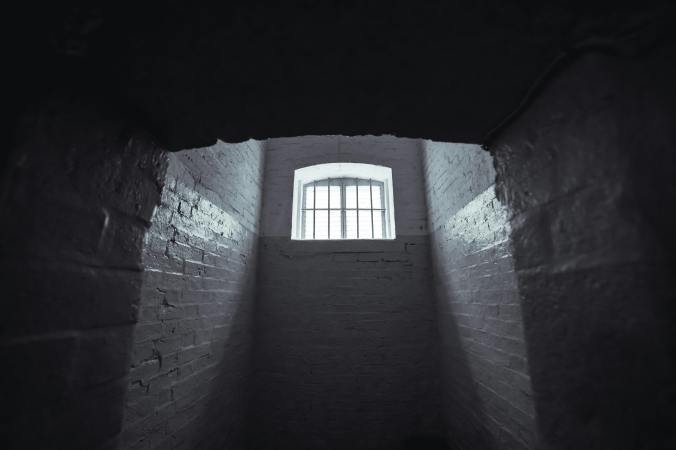
Like the 6th Avenue Bridge, the Robinson Street Bridge had been destroyed at Zero Hour. Mirroring 6th Avenue’s Arch of Mercy, the Arch of Memory welcomed those who crossed the Brennert River, on whose banks stood the Titan City Correctional Facility.
The TCCF had been home to Hank Mills since 1988, adding thirty-one more years to the five he spent before. At the age of sixty-six, Hank had lived over half his life incarcerated, and that was working out just fine as far as he was concerned.
Four years busting the skulls of Titan City criminals made it dangerous to keep the former Crimson Wraith with the general population — for him and them both. Besides, significant portions of the law enforcement community quietly appreciated Hank’s work and wanted to protect him from threats of harm.
So, he had been placed in a control unit that typically housed elderly inmates and those living with chronic disease. Both of these groups were at risk of abuse from other inmates, and Hank immediately went about making himself helpful to those who looked like they could use helping.
During his first period of incarceration, Hank had felt like an awful waste of a human being who needed constant punishment. This time, though, he came in feeling like the world was pretty damn awful all by itself. While some people may have been born with the ability to manage that awfulness, Hank didn’t figure he was one of them. He had decided that, really, he was just too dumb to keep from screwing things up, and the smartest thing he could do was to accept it.
In 2005, a twenty-five-year-old Kevin Snyder showed up at TCCF unannounced to visit him. The kid had money, the kind that changes skylines.
His father’s company, SnyTech, had just bought Finn Industries, and in order to show their commitment to public welfare, the newly formed Snyder-Finn dedicated additional funding to the humanitarian work of the Finn Foundation. That included criminal rehabilitation programs.
Back then, Kevin had said, “Our attorneys took a look at your case, and they think you’d be an ideal candidate for early release. Over fifteen years now, you’ve been a model inmate. There could be post-release opportunities…”
“No,” said Hank.
It wasn’t like him to interrupt people, but he had learned there was a point where the tone of someone’s voice tells you what you need to know, more than their words.
Kevin didn’t seem to understand. “Really, there would. Opportunities in terms of employment and housing. This could be a chance to…”
“No.”
That was the problem; this kid believed there was a chance and he wanted Hank to believe as well. That kind of thinking was for people who don’t know better.
They would take “chance” as a thing to strive and risk and sacrifice for. Hank had come to believe that wasn’t a very good thing at all. In prison, he had seen men drive themselves crazy dreaming of a chance like that. Those who adjusted themselves to the realities of the here-and-now did a lot better.
“Mr. Mills, I…”
“Hank,” he said. “My name is Hank.”
“Right, Hank…”
The kid seemed confused. Maybe his money had made it so he wasn’t used to hearing “no.”
That made Hank feel a little bad for him. It meant he had been kept a child too long and would make it all the more disappointing when life forced him to grow up.
Kevin tried again, “You know, it was a senior member of our board, Michael Conroy, who personally selected your case.” His voice took on the strain of someone trying to say something in between the words they were using to say it. “Maybe you’re familiar with Michael Conroy? He used to be the CEO of Finn Industries before the merger?”
Hank caught the suggestion. Clearly this kid knew the Crimson Wraith. “I used to know Michael.”
“Well, you should know that he seems to have a personal interest in giving you another chance out there.”
There was that word again. Hank had no interest in anything to do with it.
“Tell Michael thanks,” he said. “Tell him I’m where I’m supposed to be.”
For the last seventeen years, Michael had put a little money in Hank’s prison account every month. For the most part, Hank didn’t withdraw any. When he did it was often to do a favor for another inmate. There came the occasional letter from Michael too and cards on holidays as well.
Soon after that first visit, Hank received a letter from Kevin. He informed Hank of Michael’s passing, which he said had been due to an industrial accident. But Kevin assured him that what needed to be done in response to that death had been handled. “He has received his justice.”
Hank had to sit with that one for a moment. Michael had been a good guy, a true believer in the mission to defend the defenseless. But it also seemed to Hank like this was the fate of most Crimson Wraiths, sooner or later.
Kevin also let him know that Michael had a provision in his will that Hank would continue to receive those monthly contributions to his account, and he once again extended the offer for assistance from the Finn Foundation.
A few more letters followed. Hank never wrote back. He had never written back to Michael either.
Within a year the letters ended, with Kevin saying, “I accept that you have made your desires known. You will always have a friend out here if you wish to have a friend. Until then, I leave you in peace.”
On a drizzly October day in 2019, Hank had started the morning by playing checkers with an inmate named DeBord, who was too much of an asshole for anyone else to bother with. But over the past month, Hank had figured out that a few rounds of checkers after breakfast made it so DeBord went easier on other folks in the afternoon. So, he took one for the team, quietly letting DeBord vent his complaints about the cold eggs at breakfast and his son not sending enough money and one correctional officer who he said had “such an attitude.”
When DeBord said something about her race though, Hank laid his meaty hands flat on the table, a sign that they would not engage in the game until this matter was addressed.
“You know I don’t like that,” said Hank. “Say something about the color of her skin again, and I am done playing for today.”
This was a boundary Hank had defended before. There was never rancor in his tone — there wouldn’t have been any point in any. But DeBord had lost out on their checkers games this way once before, and he didn’t want that repeated.
Gripping the pole of his IV drip for strength, DeBord screwed up his face from a scowl of disgust to a wince of acceptance and stated his apology. The game proceeded.
After lunch, when Hank was told he had visitors, he was surprised. But he was not surprised to hear it was the kid again. There had been no other visitor in almost fifteen years.
When he arrived in the meeting room, though, he saw the kid wasn’t alone. Stephen was there. Hank liked Stephen.
The kid was no longer a kid anymore, and he had a new kid with him — a girl who looked kind of like a boy in that suit she wore.
Hank sat down across from them at a table that had been bolted down to the floor. What Kevin, Stephen, and the new kid wanted from him, he didn’t know, but he knew what they were going to offer in exchange. Kevin had that same look in his eyes, telling Hank that the desire to extend what he thought of as help had not vanished over the years.
There was no point in giving him the chance. Before any other word was spoken, Hank looked Kevin in the eye and said, “No.”
 The Crimson Wraith